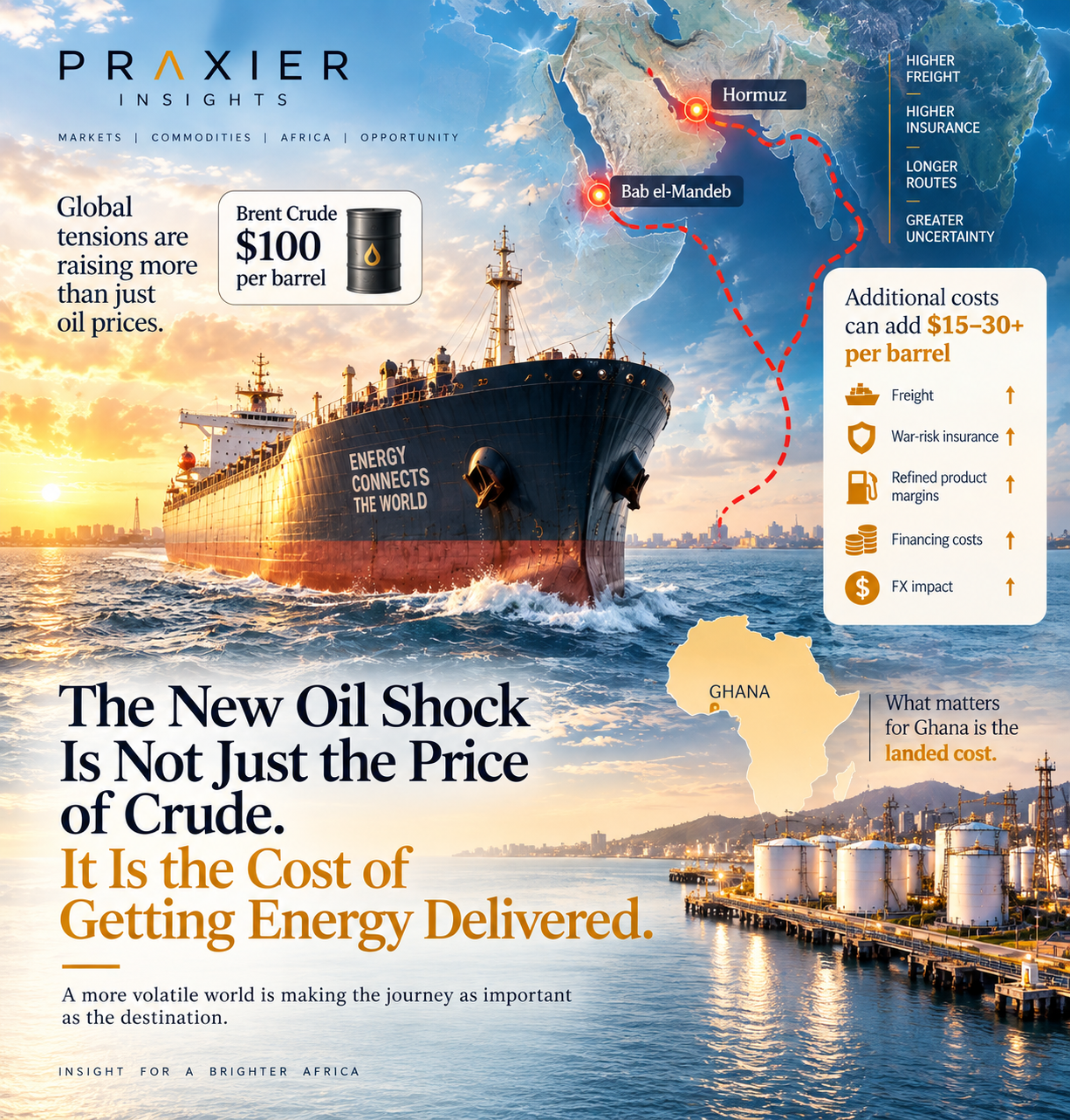
The real cost of an energy shock is increasingly determined not only by the price of the barrel, but by the cost of getting it delivered.
Global oil markets are again focused on a familiar number: the price of crude. The International Energy Agency’s September report put Brent futures at about $105 a barrel as conflict in the Middle East disrupted production and constrained critical energy corridors.
But the benchmark tells only part of the story. The more consequential development may be occurring between the oil field and the destination market.
The Landed Barrel
The economic price paid by an importing country is not simply Brent. For refined fuels, the cost chain is closer to:
Crude + refining and product premiums + freight + insurance + financing, converted at the prevailing exchange rate = landed energy cost.
For an importer buying finished fuel, refining economics are already reflected in the product price. Taxes and domestic distribution then shape the price at the pump.
Several links in that chain are becoming more expensive. At the APPEC conference on 9 September, ENOC director Paul Bradshaw estimated that transit-related costs through Hormuz could reach $10 million to $20 million per cargo as war-risk and cargo insurance premiums surged. Fewer shipowners were willing to accept the risk, while some cargoes faced longer routes.
The disruption extends beyond Hormuz. The Houthis’ advance to Perim Island has increased the threat to Bab el-Mandeb, the passage linking the Red Sea and Gulf of Aden. Two critical energy arteries are now exposed simultaneously.
When Price Risk Becomes Delivery Risk
The IEA now forecasts a year-on-year decline in global oil supply of 5.7 million barrels per day in 2026. Gulf refined-product exports remain severely constrained, while refining margins and tanker costs have risen sharply.
The crude price can fall while the delivered cost of energy remains elevated.
Freight and insurance may stay expensive, routes may remain longer, and financing requirements may increase. The benchmark and the landed barrel can therefore diverge.
The African Exposure
For many African economies, energy shocks quickly become foreign-exchange, inflation and fiscal shocks. Ghana provides a useful example.
In its 30 August statement for September’s first pricing window, COPEC reported that the cedi had appreciated by about 2.4% and crude prices had declined slightly. Yet it projected a higher petrol price: international petrol prices had risen by 10%, outweighing the currency gain.
That is the landed-cost problem in miniature. A stronger currency and a lower crude benchmark do not necessarily protect consumers when the product being imported becomes more expensive.
Rethinking Energy Security
For Ghana and other African importers, the strategic question should move beyond “What is the oil price?”
What is our fully landed energy cost — and where in that chain are we most exposed?
That changes the policy conversation. Strategic fuel stocks, viable refining capacity, diversified procurement, shipping arrangements and FX liquidity all matter. So does the ability to source products through multiple physical routes.
The broader lesson applies across commodity markets: pricing an asset is not the same as understanding the infrastructure required to make it economically available.
In stable periods, that distinction can appear insignificant. During geopolitical disruption, it becomes the market.
Energy security begins with access to the barrel. Resilience depends on understanding the full cost of getting that barrel home.